News
FTTH ecosystem map in Spain: wholesale fiber agreements


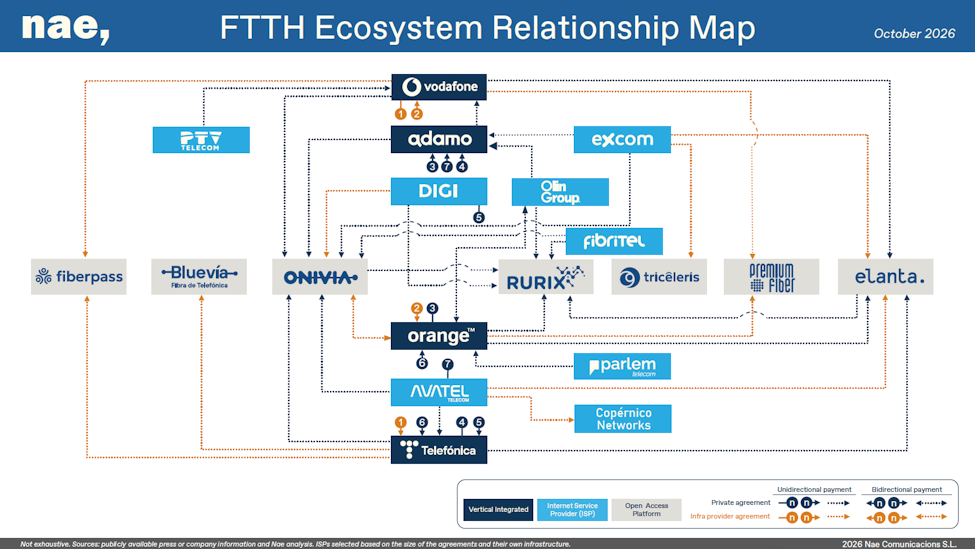
The second edition of our FTTH Ecosystem Relationship Map covers 19 players and 40 wholesale relationships among vertically integrated operators, open access platforms, and ISPs in Spain. Telefónica, Vodafone, Orange, and Adamo each have agreements with the other three, and the open access network Onivia has as many relationships on the map as Telefónica and Orange.
FTTH ecosystem map in Spain (October 2026): all four vertically integrated operators hold wholesale agreements with one another


Key findings from the October 2026 map
Telefónica, Vodafone, Orange, and Adamo, the four vertically integrated operators, each have agreements with the other three. They are also party to 27 of the 40 relationships on the map.
Onivia, an open access network that sells infrastructure only to other operators, has nine relationships on the map, the same number as Telefónica and Orange.
Infrastructure provider agreements, based on long-term lease or right-of-use (IRU) contracts, account for 13 of the 40 relationships, almost a third of the total.
Avatel, with five relationships, is the ISP with the most agreements on the map.
Qué ha cambiado desde abril de 2026
The first edition of the FTTH Ecosystem Relationship Map, published in April 2026, covered 18 players and 37 relationships. Six months later, the map has one more player and three more relationships, and its makeup has changed:
Asteo and Rede Aberta now appear through Rurix, the platform they use to share fiber infrastructure in rural areas. Both companies keep their own brands and operations. Rurix has six relationships: with DIGI, Elanta, Fibritel, Olin Group, Onivia, and Orange.
Olin Group joins the map as an ISP with its own fiber network, with agreements with Adamo, Orange, and Rurix.
Copérnico Networks joins as an ISP, with an infrastructure agreement with Avatel.
Infrastructure provider agreements rise from 11 to 13.
Orange appears under its new corporate name, which replaced MasOrange in September.
How Spain’s wholesale fiber market works
According to the CNMC, Spain’s markets and competition regulator, the country had 81.5 million fiber-to-the-home (FTTH) access lines deployed across all operators’ networks at the end of the second quarter of 2026, and fiber accounted for 91.4% of fixed broadband lines. Part of that network is sold through wholesale agreements, which allow one operator to serve its customers over another operator’s network. The map identifies three types of players and two types of agreements.
Vertically integrated operators
They own their networks, sell services to end customers, and lease network access to other operators. On the map: Telefónica, Vodafone, Orange, and Adamo.
Open access platforms
Also known as neutral networks, they build and operate fiber networks but do not sell to end customers. Their business is leasing infrastructure to other operators. On the map: Onivia, Bluevía, Fiberpass, Rurix, Tricèleris, Premium Fiber, and Elanta.
Internet service providers (ISPs)
They sell services to end customers and combine their own infrastructure with network capacity leased from third parties. On the map: DIGI, Avatel, Excom, Fibritel, Parlem, PTV Telecom, Copérnico Networks, and Olin Group.
Types of agreements
The map distinguishes between private agreements for access to specific ports and infrastructure provider agreements, which are based on long-term lease or right-of-use (IRU) contracts. It also shows whether payment in each relationship flows in one direction or both.
Why competing operators lease fiber from one another
“In Spanish fiber, operators compete for the end customer. On the network side, the same operators lease infrastructure from one another and share neutral providers. That dual role explains much of how fiber has reached almost every part of the country without each operator having to build its own network everywhere,” says Joaquín Guerrero, Director at Nae.
We look at this dynamic in more detail in “Why Spain’s telecom operators compete for customers and share fiber networks.”
Methodology
The FTTH Ecosystem Relationship Map is based on publicly available press and company information and on our own analysis. ISPs were selected based on the size of their agreements and their own infrastructure. We update the map every six months, in April and October.
Download the full map (PDF)
Other news

Introducing the first FTTH ecosystem map in Spain
The analysis identifies 18 key players and maps 37 types of agreements across wholesale, open access, and retail models shaping Spain’s FTTH ecosystem