Article
How to evolve toward intelligent pre-sales in telecommunications


Advanced telecom pre-sales models help organizations respond more consistently to complex RFPs, improve bid management, and scale commercial capabilities more effectively
The growing number of complex RFPs and tighter delivery timelines is accelerating the need for telecom organizations to evolve pre-sales models that still rely heavily on manual processes, limited tools, and knowledge concentrated in a few key individuals.
As discussed in “Pre-sales in telecom: a critical driver of business growth”, pre-sales has a direct impact on an organization’s ability to compete and convert opportunities into contracts.
In “The four levels of pre-sales maturity in telecommunications”, we also explored how this function evolves from reactive models to more integrated structures focused on strategic bid management.
Moving toward intelligent pre-sales requires organizations to progressively strengthen their operational, organizational, and technological capabilities.


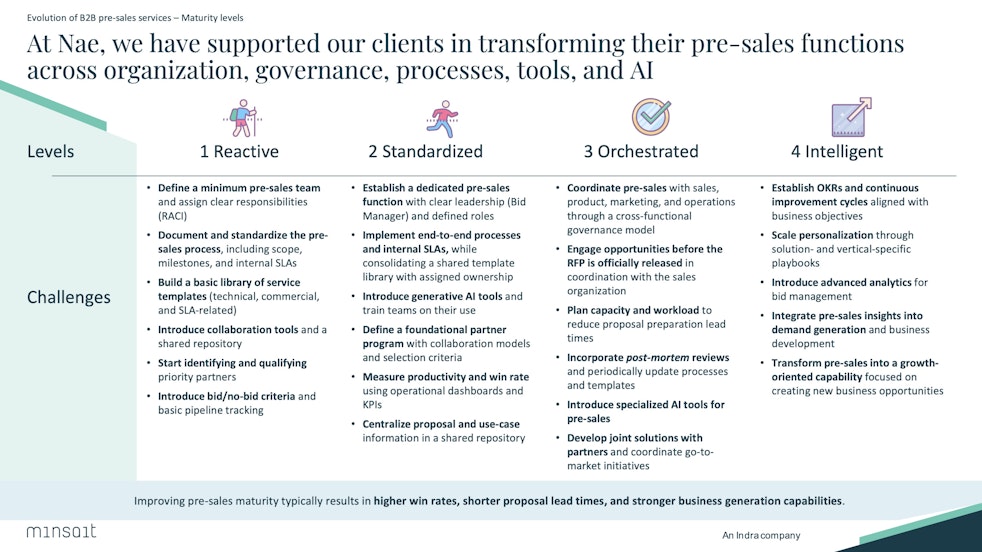
Advancing in this transformation allows companies to manage opportunities more consistently, improve coordination across teams, and respond more effectively to increasingly complex commercial processes.
Benefits of mature pre-sales models in telecommunications
As pre-sales capabilities evolve, organizations improve their ability to respond consistently to tenders and RFPs.
Standardization reduces variability across proposals and helps teams leverage knowledge gained from previous opportunities. It also improves coordination between sales, technical, financial, and operational departments.
In highly competitive telecom environments, this evolution helps reduce response times and provides greater visibility into the resources allocated to each opportunity.
More structured pre-sales functions also make it easier to develop proposals that are better aligned with customer needs while ensuring operational and financial sustainability.
Pre-sales maturity also determines an organization’s ability to participate in large transformation contracts, coordinate partner ecosystems, and manage bids with significant technology integration requirements.
Governance and organizational structure in telecom pre-sales
One of the most significant changes involves establishing pre-sales as a structured organizational function.
In reactive models, proposal development usually depends on professionals who balance bid activities with operational responsibilities. As maturity increases, organizations introduce dedicated roles focused on coordinating opportunities and managing complex bidding processes.
The introduction of profiles such as Bid Manager helps structure proposal management and formalize bid/no-bid decision-making processes.
This evolution also drives tighter integration between pre-sales, sales, product, operations, and finance teams. In mature organizations, this coordination becomes part of everyday operations rather than relying on informal relationships.
Progress in this area requires clearly defined responsibilities, governance frameworks, and greater visibility into workloads and resource allocation across proposals.
Standardizing pre-sales and bid management processes
As the pre-sales function evolves, organizations introduce shared methodologies, standardized documentation, and more structured workflows. The goal is to reduce dependency on individual expertise while maintaining consistency across proposals.
In advanced models, the pre-sales process is managed end-to-end, from opportunity identification to delivery and operational handover.
Continuous improvement also becomes increasingly important. Win/loss analysis and post-mortem reviews help organizations identify patterns, detect weaknesses, and refine both technical and commercial strategies for future bids.
Standardization does not mean creating rigid proposals. The most mature models combine common methodologies with the flexibility to adapt to each client’s or RFP’s specific requirements.
Pre-sales tools, automation, and AI in telecom bid management
In many telecom organizations, pre-sales tools are still limited to basic office software and document collaboration platforms. This creates challenges around traceability, cross-team coordination, and knowledge management.
As maturity increases, organizations adopt centralized repositories, collaborative platforms, and solutions capable of automating parts of the proposal development process.
The adoption of CPQ (Configure, Price, Quote) solutions helps structure proposals more efficiently and accelerates quotation generation in complex environments.
Artificial intelligence is also becoming increasingly relevant within telecom pre-sales functions. Initially, AI is often used to support writing tasks or document analysis. Over time, more specialized AI tools emerge to improve proposal management, automate repetitive activities, and facilitate access to knowledge generated from previous opportunities.
This allows teams to focus more on solution design and proposal customization in complex bidding environments.
Managing partners and the telecom pre-sales ecosystem
In less mature organizations, partnerships are often established only to address the specific needs of individual opportunities. In more advanced environments, however, organizations develop stable and long-term partner relationships.
This enables companies to build more comprehensive proposals and participate in tenders with greater technical, operational, or geographic complexity.
In mature models, partner collaboration becomes part of the broader commercial strategy through co-development initiatives, joint solution creation, and coordinated go-to-market activities.
KPIs and metrics for telecom pre-sales performance
Measurement is essential to understanding how pre-sales functions actually perform and which factors influence proposal outcomes.
KPIs help organizations evaluate how resources are allocated across opportunities, how response times evolve, and which elements affect proposal success rates.
Advanced organizations use metrics such as win rate, workload management, resource planning, and operational performance to make decisions around priorities, capacity, and organizational evolution.
Access to reliable data also helps identify bottlenecks and guide improvements across processes, tools, and operational management.
Pre-sales as a strategic function in telecommunications
The evolution of pre-sales is not simply about adopting new tools or expanding proposal teams.
Transformation happens when opportunity management successfully integrates commercial, technical, and operational capabilities under a shared working model.
In a telecom market increasingly shaped by complex procurement processes, tighter margins, and growing pressure on response times, pre-sales is becoming a critical function for competing effectively and sustaining long-term commercial growth.