Article
The four levels of pre-sales maturity in telecommunications


Nae’s telecom pre-sales maturity model helps organizations understand how bid management capabilities evolve and which factors shape their ability to compete in complex RFP and tender processes
Pre-sales does not operate the same way in every organization. In the telecommunications industry, where tender processes and requests for proposal (RFPs) are becoming increasingly demanding, these differences are especially visible.
As explored in the article “Pre-sales in telecom: a critical driver of business growth”, the way pre-sales is structured has a direct impact on a company’s ability to compete and convert opportunities into contracts.
There are clear differences in how teams are organized, how technical and commercial proposals are prepared, and how decisions are made throughout each opportunity. These differences help explain why some companies consistently win more business than others.
To assess these variations, organizations need a framework that helps evaluate how their pre-sales function is structured and managed.
A maturity model for telecom pre-sales organizations
Nae’s pre-sales maturity model provides a structured way to assess how pre-sales operates within an organization and how integrated it is into the commercial process.
Its goal is to identify each organization’s starting point and guide potential improvements in bid management and proposal development.
The model evaluates four key dimensions that directly influence pre-sales performance:
Organization and governance
Defines how the pre-sales team is structured and how it interacts with departments such as sales, operations, and product.
Processes
Covers how opportunities are managed and how technical and commercial proposals are developed.
Tools
Measures the level of digitalization, automation, and collaborative capabilities supporting pre-sales activities.
Partnerships and strategy
Assesses the organization’s ability to build joint proposals with partners in complex procurement and tender processes.
Based on these dimensions, the model defines four maturity levels that describe the evolution of the pre-sales function.


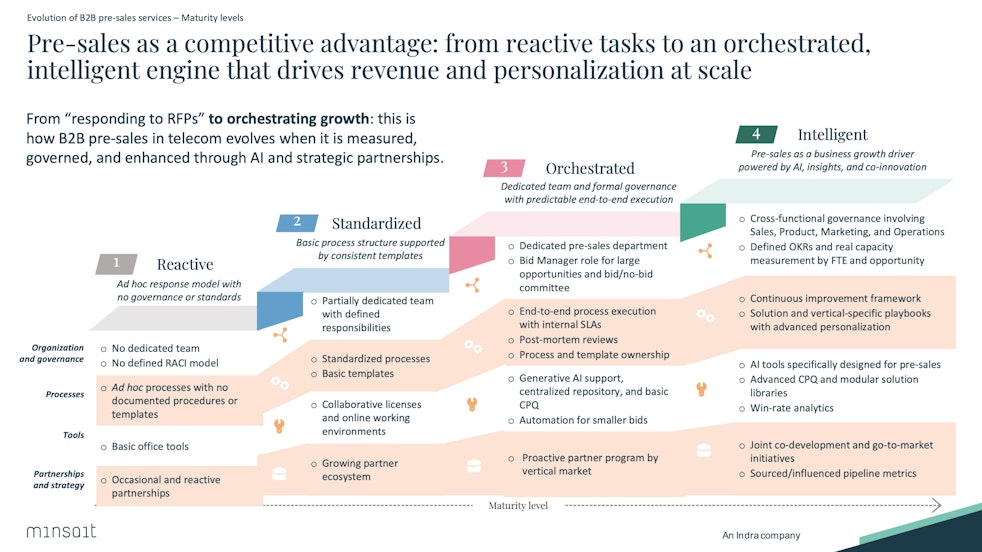
Level 1: Reactive pre-sales
At this stage, pre-sales is not formally established as a function. Proposal development depends on the availability of different professionals, who usually combine this responsibility with operational or other business tasks.
There is no dedicated team or clear ownership of responsibilities. Organizations also lack visibility into the resources allocated to each opportunity or RFP.
Every proposal is developed differently, without standardized methodologies or templates for technical or commercial responses.
Tools are basic and, in some cases, limit collaboration during proposal development.
Partnerships are activated on a case-by-case basis, often relying on external organizations with more mature pre-sales capabilities.
Level 2: Standardized pre-sales
At this level, organizations begin introducing structure into the pre-sales function, although only partially.
Specific roles emerge to coordinate proposal development, particularly in strategic tender processes. However, pre-sales is still not established as a dedicated department and does not yet maintain seamless collaboration with other key business areas.
Processes start to become documented. Guidelines and proposal templates are introduced, although their use is not always consistent across opportunities.
Collaboration tools improve teamwork, but knowledge management remains limited. Templates are not updated regularly and ownership is often unclear.
Partnerships begin to consolidate, although they are still driven more by the specific needs of each bid than by a defined strategic approach.
Level 3: Orchestrated pre-sales
At this stage, pre-sales becomes a fully recognized organizational function with a direct impact on opportunity management and proposal quality.
Organizations establish dedicated teams, clearly defined roles, and stronger integration with sales departments. For strategic opportunities, roles such as Bid Manager are introduced alongside formal bid/no-bid decision mechanisms.
The process is defined end-to-end, from opportunity identification to proposal submission. Proposals follow a common methodology, improving consistency in highly competitive environments.
Post-bid win/loss analysis becomes standard practice to evaluate results and refine future bidding strategies.
From a technology perspective, organizations adopt more integrated environments, including centralized repositories, basic automation capabilities, and early use of artificial intelligence to support proposal development.
Partnerships are managed proactively, enabling stronger and more competitive responses in complex tenders.
Level 4: Intelligent pre-sales
At the most advanced level, pre-sales is fully integrated into the company’s business strategy and plays an active role in revenue generation.
Teams work in close coordination with sales, product, marketing, and operations departments. Organizations define clear objectives, performance metrics, and governance mechanisms.
Processes are fully standardized and continuously reviewed. Proposals combine reusable assets with a high level of customization tailored to each client or RFP.
Technology platforms automate parts of the proposal lifecycle, structure knowledge management, and provide commercial performance insights. Specialized AI tools are actively used to support pre-sales activities.
Partnerships become part of the business model itself, including joint solution development and coordinated participation in strategic procurement processes.
Understanding your telecom pre-sales maturity level
Each maturity level represents a different way of organizing pre-sales and, ultimately, a different ability to compete in the market.
The model helps organizations understand where they stand and which factors influence their ability to develop competitive proposals, respond effectively to RFPs, and scale commercial activity.
Based on this assessment, companies can define the changes needed to evolve toward more structured pre-sales models and improve success rates in new business opportunities.