News
#ColombiaTelecomBarometer Q2 2026: fiber & mobile


Revenue, fiber, mobile internet and number portability in Colombia in Q2 2026: key figures from Nae's #BarómetroTelcoColombia
Colombia Telecom Barometer Q2 2026: fixed broadband revenue up 26.6% as fiber passes 6 million connections
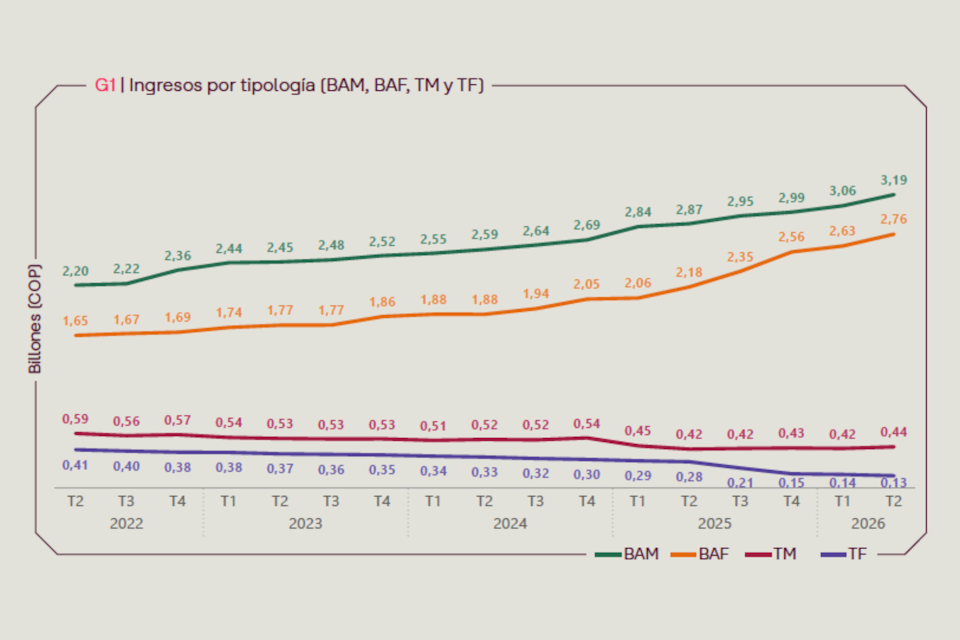
In the second quarter of 2026 (April to June), fixed broadband revenue in Colombia reached COP 2.76 trillion, up 26.6% year on year, and fiber to the home (FTTH) passed 6 million connections for the first time. Mobile broadband remains the sector’s largest source of revenue, at COP 3.19 trillion. Mobile data traffic grew 17.3% year on year, but revenue per GB in postpaid fell 9.4%.
These are some of the findings of the #BarómetroTelcoColombia Q2 2026 (Colombia Telecom Barometer), Nae’s quarterly analysis of the Colombian telecom market. It is based on data from the Ministry of Information and Communications Technologies (MinTIC) and the Communications Regulation Commission (CRC). The full report is available in Spanish.
Fixed broadband: the fastest-growing segment
Fixed broadband revenue grew 26.6% year on year to COP 2.76 trillion, the highest growth among the segments covered by the barometer. Colombia now has 10.8 million fixed internet connections, about 1.07 million more than a year earlier (+11%), and average revenue per connection rose 13.8% to COP 85,050 a month.


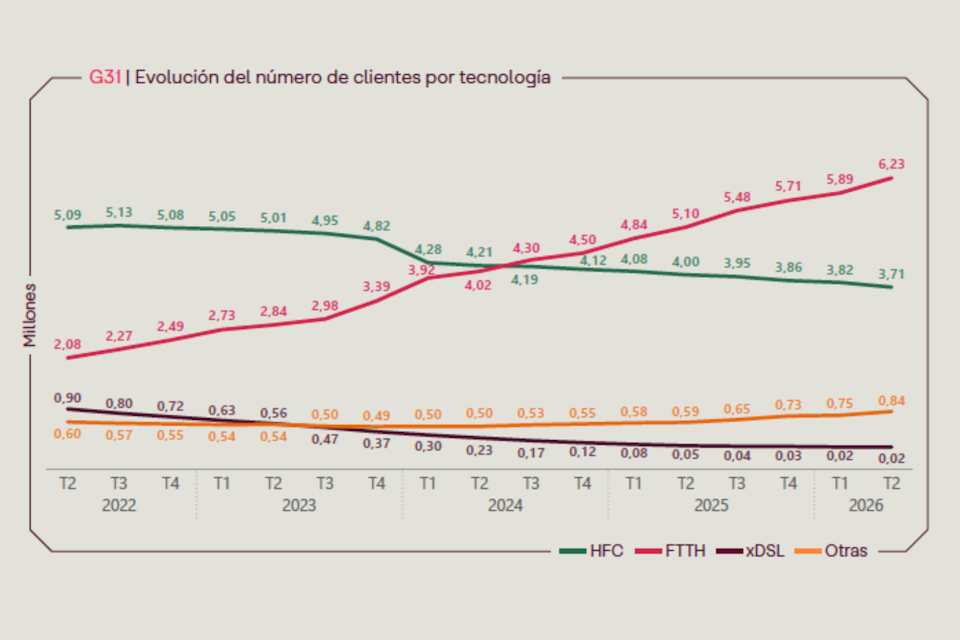
Fiber to the home (FTTH) reached 6.23 million connections, up 22% year on year, and now accounts for almost six in ten fixed connections. Cable (HFC) fell from 4 million to 3.71 million. Other technologies grew to 0.84 million, driven by satellite services such as Starlink, which now has around 190,000 connections.

Claro remains the largest fixed provider, with 3.65 million connections. Regional and specialist operators, grouped as “Others”, have 3.16 million fixed connections and the largest base in socioeconomic stratum 1, the lowest of Colombia’s six residential strata, with 1.07 million connections.
New broadband definition: 300 Mbps download
In July 2026 the CRC approved Resolution 8307, which raises the minimum speed a service needs to be marketed as broadband:
Municipalities with the most developed fixed internet markets: at least 300 Mbps download and 150 Mbps upload from 1 October 2026.
All other municipalities: 100/50 Mbps from October 2026, 200/100 Mbps from October 2027 and 300/150 Mbps from October 2028.
Ultra broadband: at least 1 Gbps download and 500 Mbps upload.
The rule does not require any specific technology or ban slower plans, but these can no longer be sold as broadband.
Mobile internet: postpaid gains ground
Postpaid mobile internet connections grew 6% to 23.04 million, while prepaid connections fell 1.7% to 26.58 million. Postpaid now accounts for 46.4% of mobile internet connections, up from 44.5% a year earlier. Claro is leading this shift, with postpaid connections up about 11% to 12.05 million.
The average prepaid user consumes 8.2 GB of mobile data a month and the average postpaid user, 19.9 GB.
More mobile traffic, but lower revenue per GB in postpaid
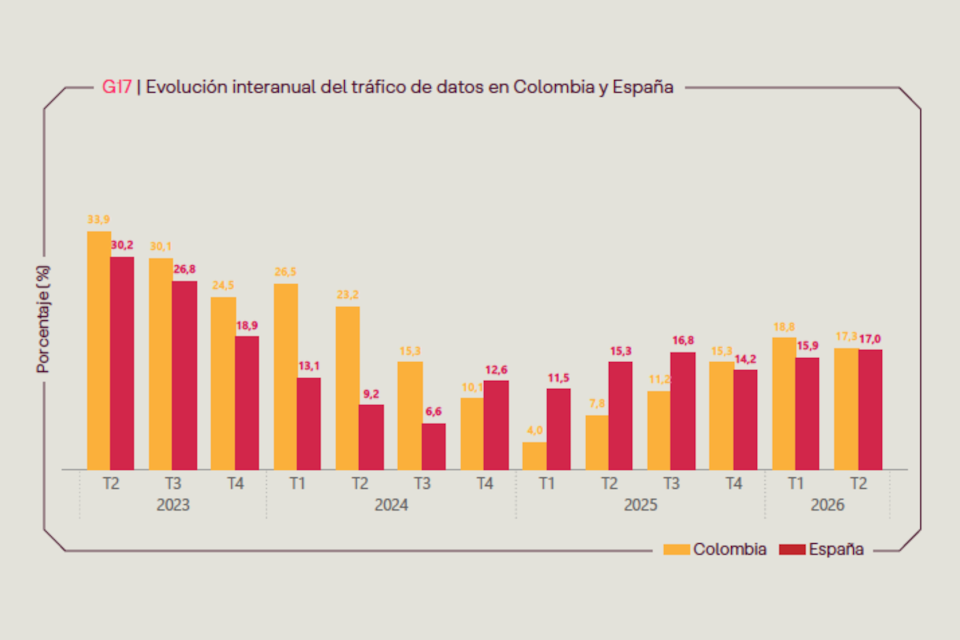
Mobile data traffic grew 17.3% year on year, almost the same rate as in Spain (17.0%, according to the CNMC). Revenue has not kept pace:
Postpaid: each GB generates COP 1,635, 9.4% less than a year earlier.
Prepaid: revenue per GB rose 4.8% to COP 1,421, and average revenue per customer grew 20.9% to COP 11,687 a month.

Number portability: Claro’s churn hits a record low and WOM turns positive
Claro recorded the lowest portability churn in the series: each month it loses 2.9 per thousand of its lines to number porting. WOM returned to positive net portability, with a net gain of 50,000 lines, for the first time since late 2023.
What the figures mean
In its “Nuestra visión” (Our view) section, the barometer highlights three conclusions:
More traffic does not mean more revenue. Mobile data use is growing at double digits, but revenue per GB is falling in postpaid. Monetising that traffic will be key for the sector.
The mobile market is moving towards postpaid. Postpaid gains share every quarter, driven mainly by Claro, although prepaid is still the majority.
Fiber is consolidating, but it will not be the only technology. The new broadband definition requires more capacity, and cable, fixed wireless access (FWA) and satellite will each play a role depending on coverage needs in each area.
“The second quarter shows a two-speed market. Fixed broadband is growing in both customers and revenue, driven by fiber, while in mobile, traffic is growing faster than the revenue it brings in. With the new broadband definition, network quality will carry more weight in competition,” said Jorge Leal, Director of Nae LatAm.
Full report
The full #BarómetroTelcoColombia Q2 2026 report, available in Spanish, includes 60 charts on revenue, fixed broadband, mobile broadband and portability by operator.
nae-barometrotelcocolombia-2026-t2.pdf
Want to understand what these figures mean for your business? Get in touch and we will go through the indicators for your market with you.
Sources: Nae’s #BarómetroTelcoColombia Q2 2026; MinTIC quarterly ICT bulletin; CRC Postdata; CNMC Data (Spain); CRC Resolution 8307 of 2026.